Do you have to label AI-generated content in Korea? What the law actually says
7 min read
Somewhere between the headlines and the group chats, a rumor has been going around: Korea now fines you for posting AI-generated content without a label. The number attached to it — ₩30,000,000 — is real. Whether it applies to you, posting a video you made with an AI tool, is a much narrower question than the headlines suggest.
- Jan 22, 2026Korea's AI Basic Act took effect
- Jul 21, 2026Its enforcement decree and labeling notices took effect
- ₩30,000,000Maximum administrative fine under Article 43
- 1 year+Grace period the ministry announced before acting on violations
What the law actually created
The Act — formally the Framework Act on the Development of Artificial Intelligence and the Creation of a Foundation for Trust (인공지능 발전과 신뢰 기반 조성 등에 관한 기본법) — is Korea's first comprehensive, binding AI law, and its transparency rule lives in a single section: Article 31. It does three things. It makes a provider of a product or service built on generative AI notify users in advance that AI is involved. It makes that same provider indicate when an output was AI-generated. And for anything synthetic — sound, an image, video — that's hard to tell apart from the real thing, it requires a notice a user can "readily recognize," with one carve-out: artistic or creative work can use a method that doesn't get in the way of enjoying it.
Whose job is it to add the label
The duty in Article 31 binds an "AI business operator" — a term Article 2 defines two ways: a person who develops and provides AI, or a person who provides a product or service that uses AI someone else built. Both count. What doesn't count, under the government's own transparency guideline, is a person using that AI "as a tool for work or creative purposes" — the person typing a prompt into an app and posting whatever comes out.
Bound by Article 31
The company behind the AI model (Suno, an image generator, a voice-cloning service) — or an app that bundles someone else's AI into its own product.
Not an "AI business operator" yourself
You, opening one of those tools, generating a track or an image, and publishing the result on your own channel. You're the user the law was written to protect, not the operator it regulates.
That split matters for a practical reason: the people who built Suno, or whatever text-to-image tool made your thumbnail, carry the Article 31 duty to flag their own output as AI-generated — not you, just for having used it.
Where the ₩30 million fine actually attaches
Article 43 sets the fine ceiling at ₩30,000,000 — but it names exactly three failures that trigger it, and mislabeling an output isn't one of them by name.
In practice, an unlabeled output gets you a correction order under Article 40 first; refusing to comply with that order is what turns into money. And the ministry has said it's giving the whole system room to settle: at a January 20, 2026 briefing, officials from the Ministry of Science and ICT said fact-finding investigations and other enforcement steps would hold off for at least a year while the government works out labeling specifics with industry — the same grace period it's applying to the broader rollout.
This isn't the only disclosure rule in play
None of this replaces a rule you may already know. Korea's Fair Trade Commission separately requires disclosing an AI-generated "virtual person" in a sponsored post — a different law (the Act on Fair Labeling and Advertising), a different agency, and one that does bind you directly whenever a brand's paying. Our guide to Korea's ad-disclosure rules covers that one in full. And platform rules — YouTube's "altered or synthetic content" toggle, Instagram's AI label — apply on top of all of it, everywhere, regardless of what any Korean statute says.
What we tell members at Soo House
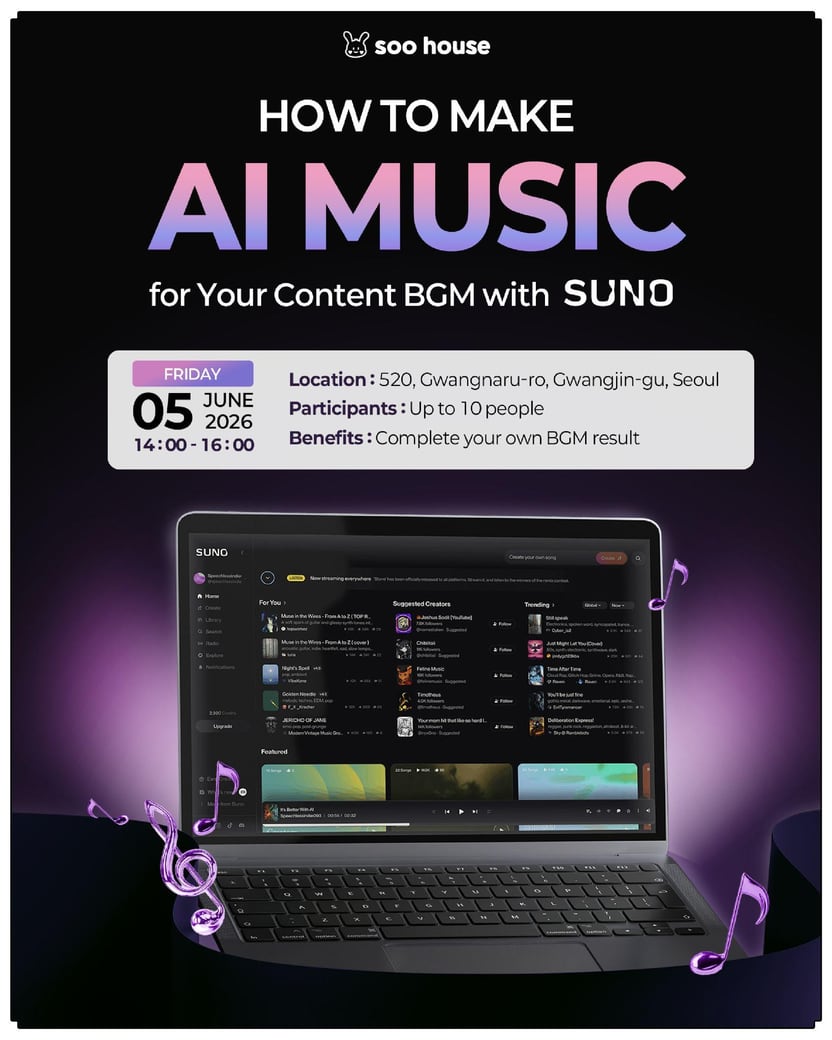
Soo House runs Make AI Music for Content, a class that teaches members — mostly expat and foreign resident creators building a channel in Korea — to generate original background audio with Suno instead of risking a copyright strike on licensed tracks. It's exactly the kind of AI-tool use this guide is about, and the question comes up in almost every session: "do I need to put an AI disclosure on this?"
The honest answer, under this specific law, is usually no — you're the user Article 31 exempts, not the operator it binds. But we still tell members to keep a one-line note of which tools they used in their own project file. Not because the law asks for it yet, but because more brand briefs are starting to, and a member who can answer that question in one sentence looks a lot more professional than one scrambling to remember which app made the track three campaigns ago.
Your Next Hop
If you're using AI tools for your content — music, voice, a thumbnail, an edit — you almost certainly don't need to add a label under this law today. Note the tool in your own records anyway, read the label on anything you've bought or been paid to post, and watch this one: the July 2026 rules are still described by the ministry itself as a work in progress.
Checked October 18, 2026. Article numbers and the ₩30,000,000 fine ceiling are from the official English text of the Framework Act on the Development of Artificial Intelligence and the Creation of a Foundation for Trust, Articles 2, 31, 36, 40 and 43, published by the Korea Legislation Research Institute. The January 22, 2026 effective date and the Ministry of Science and ICT's announced grace period for fact-finding and enforcement, from its January 20, 2026 briefing, are drawn from digitaldaily's report on the briefing. The July 21, 2026 effective date of the enforcement decree and subordinate labeling notices is drawn from Kyunghyang Shinmun's report. The internal/external labeling distinction, the no-exception rule for deepfake-style output, and the "AI as a tool for work or creative purposes" exclusion for ordinary users are drawn from Asia Economy's report on the Ministry's transparency guideline. This area is actively being refined by the ministry during its own announced grace period — confirm your specific situation against the Ministry of Science and ICT's current guidance, or a Korean technology-law counsel, before relying on any of this for a commercial AI product or service of your own.