How to grow as a foreign creator in Korea (and get paid for it)
8 min read
Korean brands spend enormous budgets on creator marketing, and a growing share of it is aimed at audiences outside Korea. K-beauty, food, fashion, travel, language, tech — all of it needs faces that look like the audience it is trying to reach.
You are in Korea. You are that face.
So why does none of it reach you?
Why the campaigns are invisible
It is almost never about your follower count. It is about the pipeline.
Agencies work in Korean. Campaign briefs, applications and contracts are posted on Korean platforms, in Korean, on a two-day turnaround. If you are not reading those platforms daily, the campaign was filled before you knew it existed.
Brands are nervous about the paperwork. Paying a foreign creator raises questions a Korean marketing manager may not know the answer to — which visa allows this, how to withhold tax, what documents they need. Faced with uncertainty, they pick a Korean creator instead. Not malice; friction.
There is no track record to point at. A brand choosing between two unknown creators picks the one with visible, verifiable history. Views on your own feed are not that. A record of campaigns actually delivered is.
Every one of these is solvable, and none of them is about being more talented.
What foreign creators actually get booked for
A realistic picture of the work that exists:
- Product seeding and reviews — beauty, food, lifestyle. Usually the entry point.
- Store and restaurant visits — go, film, post. Common, quick, reliably paid.
- Brand ambassador runs — multi-month, the most valuable thing on this list.
- UGC for the brand's own channels — you shoot, they post. Your following barely matters; your craft does.
- Events and launches — attend, cover, sometimes appear.
- Casting — commercials, music videos, background and speaking roles.
- Localisation work — voice, subtitles, cultural checking for brands going abroad.
Notice how much of that does not depend on being famous. UGC and casting pay for skill and presence, not reach. This is the part most creators miss while they wait to hit some follower number.
What it pays
Rates vary enormously, so treat ranges with suspicion. What is more useful is understanding what moves the number:
Deliverables. One story is not one reel is not three pieces of cut-down footage. Get the deliverable list in writing before you quote.
Usage rights. This is the big one, and the one creators give away for free. A brand running your face in a paid ad for six months is buying something far more valuable than a post on your grid. If usage extends beyond your own channels, the fee should reflect it.
Exclusivity. Agreeing not to work with competing brands for three months has a price.
Turnaround. A 48-hour deadline costs more than a two-week one.
New creators routinely accept a flat fee, hand over unlimited usage rights, and wonder why the second campaign pays the same as the first. Ask what the brand is buying, not just what they want you to post.
The five things to sort out before your first campaign
1. Check what your visa allows
This one first, because everything else is pointless if you get it wrong.
Paid creator work is income. On most D and E visas it requires permission; on F-2, F-4, F-5, F-6 and H-1 you generally have broad freedom. The "it's just a small collaboration" reasoning is exactly how people damage their status.
Read the Korean visa FAQ for where you sit, and ask your immigration office before you accept the first paid brief — not after.
2. Get a Korean bank account
Brands and agencies pay to Korean accounts. Foreign accounts create a problem the marketing manager will solve by choosing a different creator.
If you do not have one yet, start with how to open a Korean bank account.
3. Understand the 3.3%
Freelance fees in Korea are typically paid with tax withheld at source — commonly 3.3% for individual contractors. You receive the net amount, and the withholding is reported against your registration number.
This is normal and it is in your favour: it creates a legitimate income record. Much of it can come back to you when you file. See year-end tax settlement for how that reconciliation works.
Ask for the fee before or after tax explicitly. It is the most common misunderstanding in creator contracts.
4. Disclose paid promotion. Every time.
Korea's Fair Trade Commission requires sponsored content to be clearly disclosed — visible, in the same language as the content, not buried in hashtags at the bottom or hidden behind "more".
This is not optional, and enforcement is real. It is also the thing that separates creators brands trust from creators they use once.
5. Build a one-page media kit
Audience demographics, engagement rate, past work, rates, contact. In English and, ideally, Korean.
Most foreign creators do not have one. Having one puts you ahead of them in an inbox.
Where the opportunities actually are
This is the problem Soo House exists to solve: campaigns from Korean brands, agencies and institutions, published in a place foreign residents actually look, in a language they read.
Discover carries live campaigns, castings, events and paid projects, curated for foreigners rather than translated as an afterthought. Categories run across marketing, jobs and gigs, events and tours, research, education and settlement.
Three things make it different from scrolling Korean platforms hoping:
You see the payout before you apply. The reward is on the listing. No negotiating in the dark, no "we'll discuss budget later."
You get paid on verification, not on invoice chasing. Once your participation is confirmed — the visit, the content, the mission — Points land in your wallet. Withdraw them to your bank, or spend them on member perks.
Your record compounds. Every completed campaign builds a history that unlocks bigger and better-paid opportunities. That track record is exactly the thing brands were missing when they picked someone else.
That last point is the whole game. The first campaign is small on purpose. The tenth is not.
The part most creators skip: getting better
Reach without craft plateaus fast. The creators who move from product seeding to ambassador contracts are the ones whose work looks like it belongs on the brand's own channel.
Soo House runs classes and workshops for exactly this, alongside the campaigns — recent programmes have included:
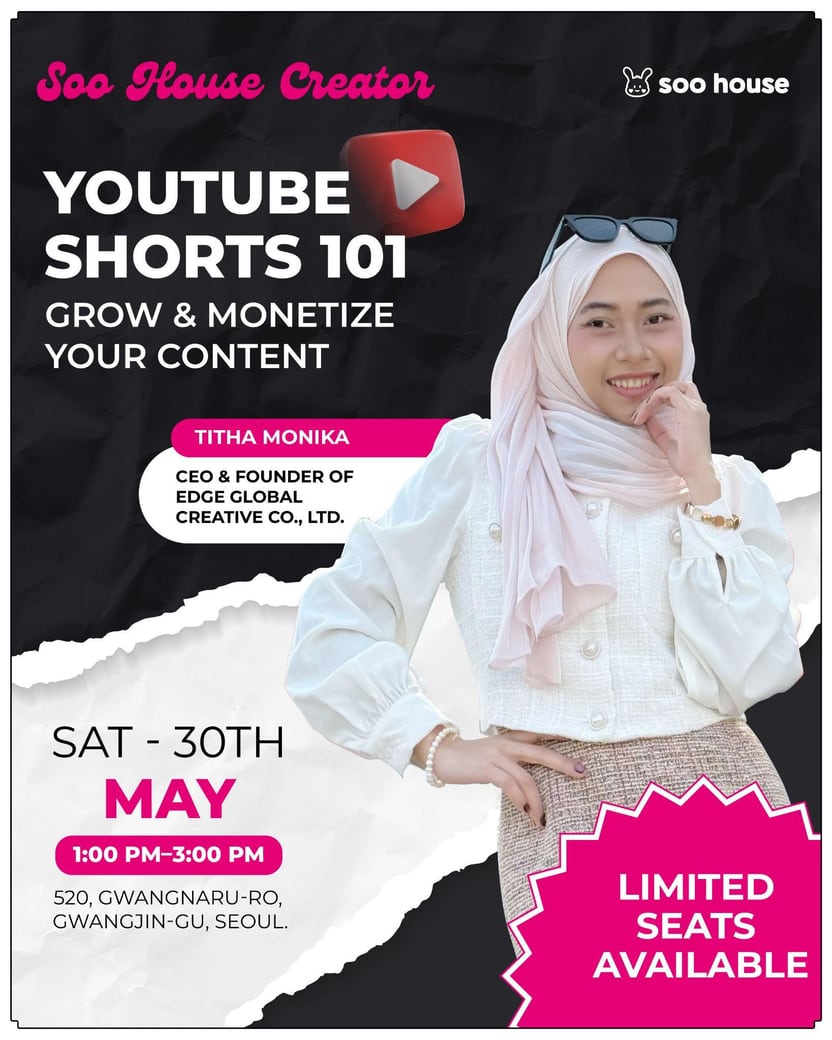
- YouTube Shorts 101 — short-form structure and monetisation
- Shoot Clean K-Beauty Content — the lighting and framing standard Korean beauty brands expect
- Make AI Music for Content — original audio without licensing problems
- K-Beauty Portfolio Workshop — building the portfolio that gets you cast
- Beauty Creative Force — paid recruitment into brand creative work
- Business Korean — the vocabulary that lets you read a brief and negotiate a rate
Some are free, some are paid, some pay you to take part. Running through them is also how you meet the people booking the campaigns — a class taught by an agency is a room full of the person who decides.
A realistic first ninety days
Weeks 1–2. Confirm your visa position. Open a bank account if you need one. Write the media kit.
Weeks 3–6. Apply to everything you are eligible for, including the small ones. Deliver early. Over-deliver once — an extra cut, better audio, a version in another language. This is how you get asked back.
Weeks 7–10. Take a craft class. Rebuild your portfolio around your two best campaign deliverables rather than your personal favourites.
Weeks 11–13. Go back to brands you delivered well for and ask directly about longer-term work. Ambassador contracts almost always come from an existing relationship, not from a cold pitch.
Nothing there requires a large following. It requires showing up ten times when most people show up twice.
What actually holds people back
Waiting for a follower milestone. UGC and casting work does not care. Start now, at whatever size you are.
Only pitching in English. A three-line Korean introduction — even an imperfect one — visibly changes reply rates.
Undercharging permanently. Being cheap for your first campaigns is a strategy. Being cheap for your twentieth is a habit.
Treating it as a side thing. Delivering late once removes you from the list quietly, and nobody tells you.
Staying invisible. The creators who get booked are in the rooms — classes, meetups, launches. Korea's creator industry runs on people who have met each other.
Korea is one of the few places where a foreign creator is genuinely scarce, genuinely wanted, and structurally hard to reach. The scarcity is your advantage. The structure is what Soo House is for.
Download the app, look at what is live this week, and apply to the first campaign you are eligible for. The record starts with one.
Checked in August 2026. Visa permissions, tax withholding and advertising disclosure rules change and depend on your circumstances — confirm with immigration, the National Tax Service or a qualified professional before relying on anything here. Programme availability varies week to week.